Comparison
Your own ordering system vs Uber Eats
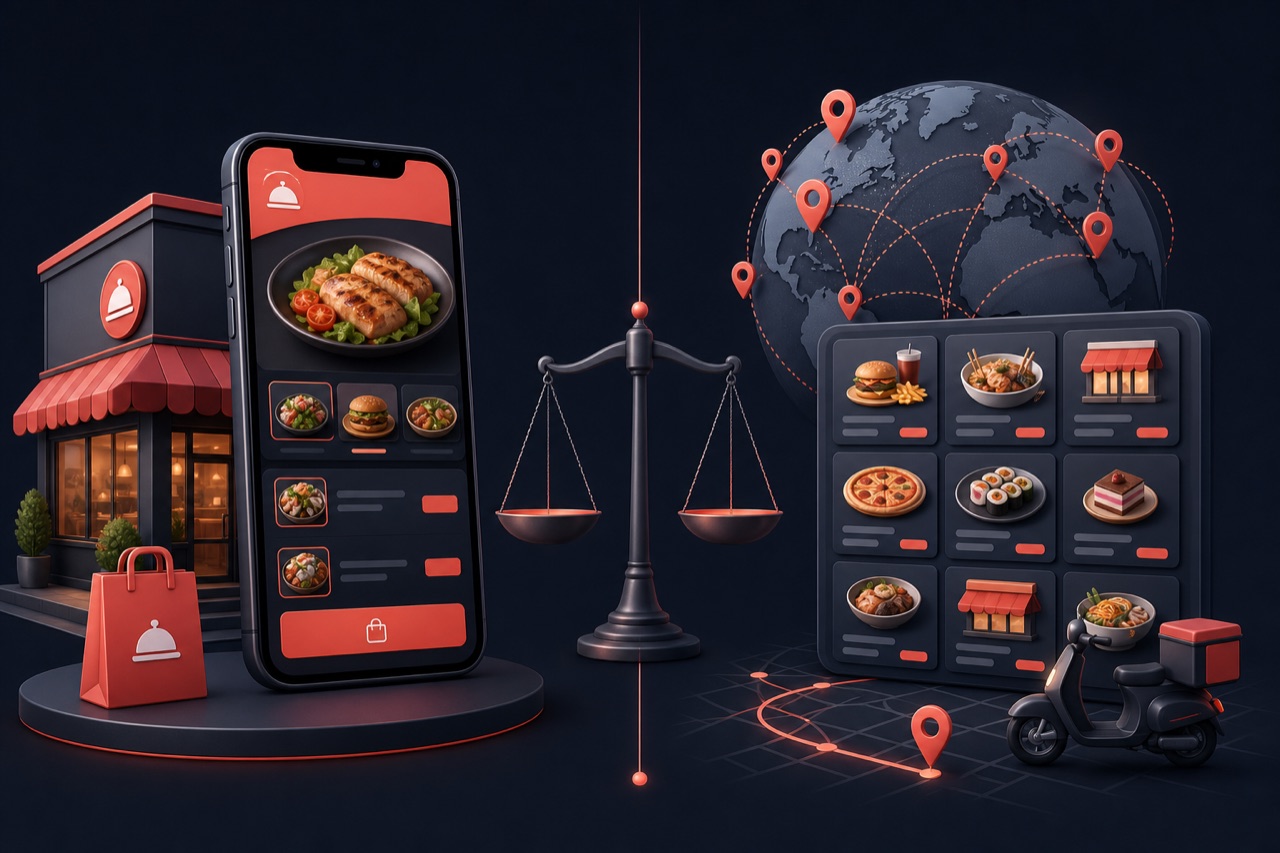
Uber Eats offers global reach and a large delivery network; your own channel protects margin and the direct customer relationship. We compare them fairly, at the model level.
Short answer
Uber Eats is a global marketplace that provides discovery, a large audience and an on-demand delivery network; in return it takes a per-order commission (and delivery fees) and owns the customer relationship. Your own ordering system runs on a fixed/package fee with no marketplace commission per order, and keeps customer data and brand with you. The healthiest approach is to use both: the marketplace for reach, your own channel for margin and loyalty.
What does each model represent?
Uber Eats is an intermediary marketplace with a global brand: customers discover restaurants in the app, and the platform handles listing, payment and (through its courier network) delivery. The cost is a per-order commission plus delivery fees, and a customer relationship that stays on the platform.
Your own ordering system (e.g. with Yededoy) is a direct channel under your own domain and brand. You manage web, QR-menu, pickup and delivery orders from one panel; the customer's name, phone, address and order history stay with you. Instead of a marketplace commission you pay a fixed/package subscription.
Model comparison
No invented rates — the structural differences between the two models.
| Criterion | Your own ordering system | Uber Eats (marketplace) |
|---|---|---|
| Commission model | Fixed/package subscription; no marketplace commission per order. | Percentage commission per order, plus delivery fees. |
| Delivery | Your own courier or delivery integration; you set zones and fees. | On-demand courier network — a real convenience and the marketplace's strength. |
| Customer data | Name, phone, address and order history stay with you. | Data mainly on the platform; limited business access. |
| Brand experience | Your own domain, design and logo. | Platform interface; your brand is one option in a list. |
| New-customer reach | Grows through your own marketing, SEO and social media. | The platform's global traffic and discovery — the marketplace's real strength. |
| Menu and price control | Full control; prices and menu update instantly. | Platform rules and price pressure apply. |
| Customer relationship | Direct; win-back via campaigns and email/SMS. | Via the platform; one-to-one contact is limited. |
| Payment and collection | Direct collection (online card or on delivery). | Through the platform; subject to payout schedule and deductions. |
| Featuring and ads | No mandatory ads to appear at the top; you grow through SEO and your own marketing. | Appearing high in the list often requires extra ad spend. |
| Contract and exit | Fixed/package subscription; commitment and exit terms are transparent. | You are subject to the platform's contract, commission plan and delivery rules. |
Which one, for whom?
The decision depends on your priority:
- If you want global discovery and an on-demand delivery network, the marketplace is strong on reach.
- If protecting margin and cutting commission cost is your priority, your own channel wins.
- If you want a direct relationship (loyalty, campaigns, repeat orders), your own channel is essential.
- If you want to control your brand and customer experience, choose your own system.
- If you just launched, the most efficient strategy funnels marketplace customers into your own channel.
Advantages of your own channel
What you gain by building your own channel without leaving the marketplace:
Lower commission cost
On direct orders you pay no per-order marketplace commission or delivery cut.
The customer is yours
With contact details and order history you build repeat sales and loyalty.
Stronger brand
You deliver a professional, consistent experience under your own domain and design.
Decisions from data
With sales reports and analytics you make menu and campaign decisions yourself.
Global marketplace cost items
On Uber Eats the total cost is made up of several items, depending on the commission plan and delivery model you choose:
Revenue commission
The percentage taken on each order's value; usually varies by plan depending on who fulfils delivery.
Delivery fee (courier network)
An added item when the platform courier is used; the commission plan changes when you use your own courier.
Service and listing package
Some plans include a separate fee for listing/service.
Featuring and ads
Optional ads to appear at the top of search and listings raise the real per-order cost.
Payment and deduction impact
Payment processing fees and platform deductions can push the net cost above the commission rate.
Gross-margin impact
Measure commission + delivery fee together against a product's gross margin; on a low-margin item the total cut can take the bulk of profit.
How to use both together
Set up the marketplace and your own channel to complement each other:
- Use Uber Eats as a storefront for acquiring new customers.
- Add your own channel's QR code and address to packaging and receipts.
- Offer a small advantage on the direct channel (a campaign or loyalty points).
- Move repeat customers to your own channel via email/SMS and campaigns.
- Compare the reports of both channels and track profitability regularly.
Related guides and solutions
Frequently asked questions
- Do I have to leave Uber Eats?
No. Most businesses use both: the marketplace for reach and its delivery network, their own channel for margin and loyal customers. The goal is to grow the share of direct orders over time.
- Without Uber Eats, how do I handle delivery?
On your own channel you use your own courier or a delivery integration and set zones and fees yourself. Many businesses keep the marketplace for delivery reach while pushing pickup and local delivery to their direct channel.
- Is there a commission on my own system?
There is no marketplace commission on direct orders. You pay a fixed/package subscription; for card payments only the payment provider's standard transaction fee applies.
- How do I move marketplace customers to my own channel?
Adding a QR code and address to packaging, offering a small advantage on the direct channel, and sending email/SMS campaigns to repeat customers all help.
- Who pays the delivery fee?
It depends on the model and commission plan; the delivery cost can fall on the business, the customer, or be split between them. On your own channel you set the delivery zone and fee yourself.
Summary
Uber Eats is strong on global discovery and its on-demand delivery network, but takes a per-order commission plus delivery fees and owns the customer relationship. Your own ordering system runs commission-free and keeps customer data and brand with you. The healthiest path is to use both: acquire new customers via the marketplace, and grow margin and loyalty through your direct channel.
Get started
Contact us about an online ordering solution for your business and start taking orders on your own channel with Yededoy.